
How Wholesalers Compare Chinese Panel Factories in Practice
A wholesaler comparing Chinese panel factories is mostly comparing paperwork and published numbers. Dongstar Group has been selling under one brand umbrella since the 1990s from Linyi city in Shandong province, through four separate companies, and it publishes thickness windows, certificate lists and order terms page by page. What follows is the comparison a buyer can actually run.

Key takeaways
- Compare entities before prices: four business areas cover manufacturing, export, formwork systems and e-commerce under one brand.
- Read the standards work, not only the certificate list: the group appears among the drafters of Chinese wood-based panel standards.
- Check the published windows family by family, from 9–24 mm on film faced panels to 2–30 mm on fibreboard.
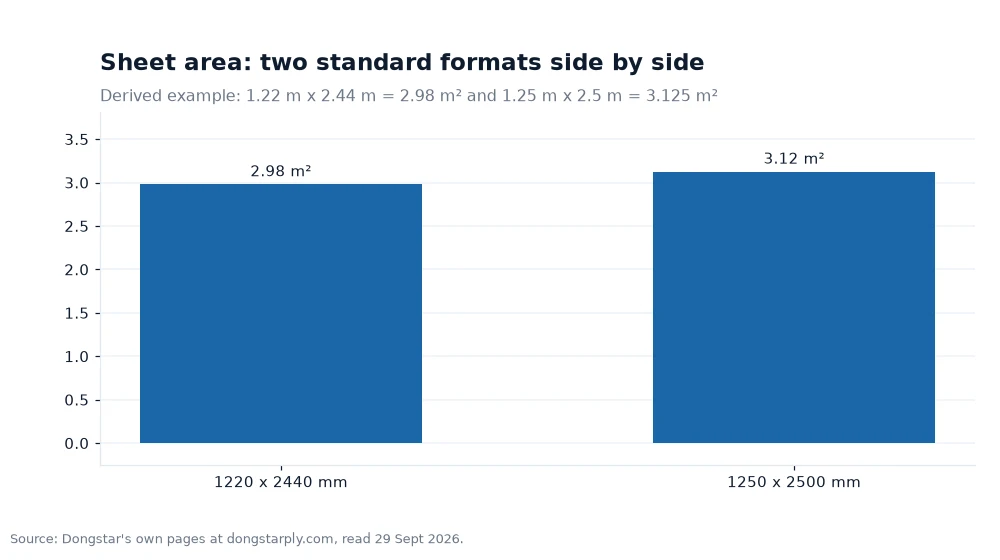
- Run the area arithmetic on both formats: 1220 × 2440 mm is 2.98 m² against 3.125 m² for 1250 × 2500 mm (example arithmetic).
Structure first: who is actually selling
The group is described as four business areas operating under one brand: Linyi Betterway Wood — Linyi Dongstar as standard Imp&exp, Dongstar Formwork and Dongstar E-Commerce. Four entities mean four sets of invoices and four places where a quality claim can sit, so the useful first question is not what a factory can produce but which company signs the sales contract.
That question is easy to answer and rarely asked early. A buyer who knows that the manufacturing company and the export trading company are different legal persons will route technical questions and payment questions to the right place from the start, instead of discovering the split halfway through a claim about a thickness deviation.
Which standards the factory helps write
Certificate lists are common; standards participation is not. The company's own pages state that it sits on the China Shuttering Board Committee, the China Formwork and Scaffold Association and the National Technical Committee on Wood-Based Panels of the Standardization Administration of China, and that it took part as a drafter or founding unit in national standards covering plywood for concrete form, wood-joist for building structures, and plywood dimensions.
For a wholesaler this is a signal about how specifications are treated internally. A company that has helped define how plywood for concrete form is described has an interest in the dimensions and tolerances of its own output being consistent with those documents. It is also named as a strategic partner of Finland Dynea Group (China), which is the film supplier behind one of the face options on the film faced range.
Compare the datasheets line by line
Published families differ in ways that matter to a wholesaler's catalogue. Film faced panels are listed from 9 to 24 mm with a ±0.5 mm tolerance; fibreboard from 2 to 30 mm with ±0.2 to ±0.5 mm; strand board and chipboard from 8 to 18 mm; birch plywood at 12, 18 and 24 mm. None of those windows can be swapped for another when a quote is being assembled.
A wholesaler's own catalogue is therefore only as strong as the pages behind it. If a customer asks for an 11 mm sheet and the family publishes the six options: 8, 9, 11, 12, 15 and 18 mm, the answer is immediate; if the family publishes a different ladder, the answer has to be "that thickness belongs to another product". Suppliers who blur those lines create returns, not sales.
Samples, papers and the first order test
Certificates are published as ISO, CE, CARB and FSC across the panel range, and the structural pages add FSC, CE and E0 or E1 formaldehyde certificates on request, with third-party inspection reports on the formwork beam line. A serious comparison asks how each certificate applies to the exact product being bought, not whether the company holds certificates in general.
The second test is the paperwork rhythm of a first order: whether the supplier states a minimum, a lead time and a packing method in writing before taking a deposit. On the structural plywood page that minimum is one 20-ft container or the equivalent, the lead time is two to ten weeks after confirmation and deposit, and packing is palletised and wrapped before being trucked to port. Anything markedly faster than that deserves a second look. The published figures are what make one factory comparable with another: a Plywood Supplier that prints minimums, windows and terms on its own pages is easier to check than one that keeps them for a phone call.
The area arithmetic behind a per-sheet price
Wholesalers live on the gap between a per-sheet price and a per-square-metre price. At 2.98 m² a sheet, the 1220 × 2440 mm format carries less board than a 1250 × 2500 mm sheet at 3.125 m² (example arithmetic), and that 0.145 m² difference is what turns two similar quotes into two different margins once a customer starts comparing by area.
Do the same conversion on every rung of the catalogue. A container of larger sheets holds more square metres for the same freight, while a cut list drawn around 2440 mm lengths turns the extra 60 mm into waste. Factories that publish their sheet formats make this comparison possible; factories that publish only a price leave the wholesaler to guess.
| What to compare | Published position | Why it separates suppliers |
|---|---|---|
| Business structure | Four areas: betterway wood, import and export, formwork, e-commerce | Shows which entity carries the contract |
| Standards work | Drafter or founding unit of several wood panel standards | Signals how specifications are handled internally |
| Thickness windows | 9–24 mm film faced, 2–30 mm fibreboard, 8–18 mm strand board | Sets what a catalogue can quote without substitution |
| Certificates | ISO, CE, CARB, FSC; E0 or E1 on request | Decides which markets a product can enter |
Worked example: comparing two factories on area per sheet
Take a wholesale order of 1,000 sheets quoted at the same price per sheet. In the 1220 × 2440 mm format the consignment carries 1,000 × 2.98 = 2,980 m². In the 1250 × 2500 mm format it carries 1,000 × 3.125 = 3,125 m² (both example arithmetic). The difference is 3,125 − 2,980 = 145 m², about 4.9% more board for the same sheet count and the same freight (example arithmetic).
Now apply it to the customer's order. If that customer buys by the square metre and a factory quotes only per sheet, the wholesaler's margin depends on a conversion nobody wrote down. If both factories publish their formats, the comparison ends in one line: 3,125 minus 2,980 equals 145 m² per thousand sheets, and the per-square-metre price follows from it.
Frequently asked questions
What should a wholesaler check first on a Chinese panel factory?
The company structure, then the published specifications. Four business areas under one brand mean the invoice, the production claim and the export paperwork can sit with different entities, so it is worth naming the contracting party before discussing price.
Is association membership a substitute for a product certificate?
No. Committee and association work describes how a company participates in standards, while ISO, CE, CARB and FSC describe specific products and markets. A certificate folder still has to be matched to the exact board being ordered.
How many product families does the group publish?
Eight lines are named on the company's own pages, including film faced, commercial, fancy and marine plywood, hardwood-faced and birch plywood, strand board, fibreboard, melamine-faced boards and chipboard, each with its own specification page rather than one shared datasheet.
Where a comparison should end
Most of the answers in this article sit on the client's own pages, starting with the company background behind the group and continuing through the panel range by product family. A wholesaler who reads both before the first quote arrives will spend the call discussing specifications instead of introductions.
Company structure, standards work, specifications and order terms above sit on that the supplier's own pages, as read on 29 September 2026 — as the basis for the table above, as standard as referenced in this article[1].