
What a Mining Pool App Should Do on Day One
A pool app earns its place by answering one question well: is the hashrate I am paying for actually being credited? At 1 PH/s, settled hourly at difficulty 132.76 T, the answer changes by about 0.0000187 BTC — roughly $1.58 — every hour, so an eight-hour blind spot is money that has already left your account.

Key takeaways
- At 1 PH/s and difficulty 132.76 T, each hour of settled PPS+ income is about 0.0000187 BTC (~$1.58); at 100 TH/s it is about $0.16 an hour, which is why alerts — not charts — are the feature that saves money.
- Per-worker hashrate is the only view that catches a fault early. A fleet-level total can stay flat while several machines are dead and others are throttled.
- Multi-account management matters the moment a second site or co-owner exists; keeping balances separate on the screen is cheaper than untangling them on the ledger.
- Real-time monitoring has to work on both iOS and Android, and it has to be usable one-handed, because faults are usually noticed away from a desk.
The short answer
A pool app should do four things on day one, and anything beyond that is optional. It should show realised hashrate per worker rather than a single account total. It should alert on a worker that stops or throttles, with a threshold you can set. It should show the balance and the settlement history so you can reconcile income against a power invoice. And it should do all of that without hiding the numbers behind a chart that only looks good at arm's length.
Everything else — news feeds, coin price tickers, referral banners — is a nice-to-have. The reason to be strict about this is arithmetic: mining income is linear in time, so the cost of a fault is the cost of the hours it ran undetected. At 100 TH/s that is roughly $0.16 an hour at $84,692; at 1 PH/s it is about $1.58 an hour.
How the mechanism works
Your miner submits shares, and the pool converts shares into a payable balance. Under PPS+ — the default method — the block-reward component is settled per share against current difficulty and paid hourly, with a listed 4% fee, while the transaction-fee component follows PPLNS logic at a listed 2% fee.[1] Under PPLNS, both components are distributed together at a listed 2% fee once a found block reaches six confirmations, weighted by each miner's share of pool hashrate over the last five difficulty rounds.
What that means for an app is simple: there are two clocks. The mining clock runs continuously and shows up as credited hashrate. The payout clock runs hourly or per block and shows up as balance. An app that only displays the second clock cannot tell you that a machine has been offline since Tuesday, because a stale balance from an earlier settlement can look like normal activity.
The first clock is the one worth watching. Realised hashrate per worker is the fastest signal available, and it is the only one that moves before the money does. This is exactly what a mobile mining dashboard should surface first when the app opens.
| Signal | Why it matters | Cost of missing it |
|---|---|---|
| Realised vs rated hashrate | Detects throttling, firmware issues and failing power supplies | A 5% shortfall at 1 PH/s is about $1.90 a day |
| Per-worker status | Separates one dead machine from a pool-wide problem | One 100 TH/s worker offline for a day is about $3.65 net |
| Balance and settlement history | Confirms the hourly cadence and reconciles against power costs | Unreconciled income hides fee and threshold surprises for months |
| Alerts with thresholds | Turns a silent fault into a notification in minutes | An 8-hour blind spot at 1 PH/s is about $12.16 net |
| Multi-account switching | Keeps separate sites, owners or coins from contaminating one view | Hours of manual cross-checking per incident |
Where miners get it wrong
The first mistake is optimising the app for the aggregate. A pool-level hashrate line that gently slopes downward is easy to explain away and almost impossible to act on. Worker-level rows are less elegant and far more useful, because they localise the fault before a support ticket is needed.
The second is tolerating alert noise. An app that notifies on every share-rate wobble gets muted within a week, and a muted app is worse than no app: it converts a detection problem into a false sense of coverage. Set thresholds that describe a real failure — a worker at zero, or a realised rate below a chosen fraction of nameplate — and keep the channel quiet otherwise.
The third is treating the phone as a replacement for a statement. Monitoring and accounting are different jobs. The phone is for the surprise at 07:00; the settlement history is for the month-end reconciliation. An app that offers both, with hourly settlement recorded per worker, removes the manual spreadsheet step that most operators quietly stop doing.
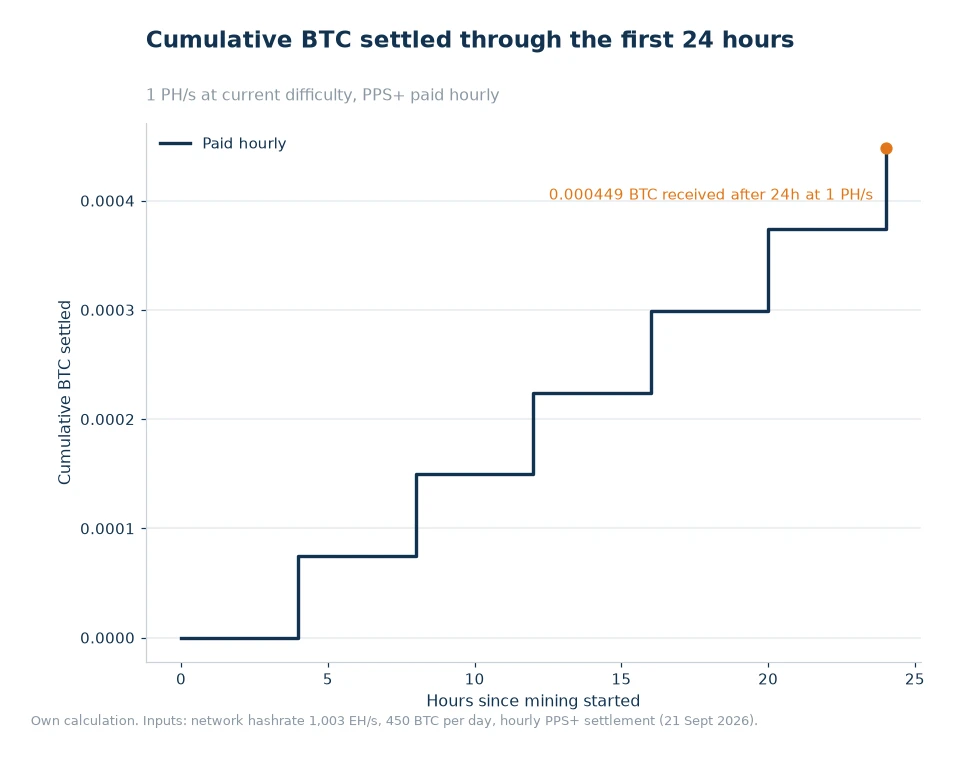
That chart is the reason hourly settlement is worth having on the screen. Each step represents one settled hour, worth about $1.58 at 1 PH/s. A gap in the staircase means something stopped — and the earlier the gap is visible, the smaller the amount it represents. Installing the app is the first step; ViaBTC App Download covers both iOS and Android builds, which matters if the person who fixes machines and the person who watches the balance carry different phones.
A checklist you can run today
- Install on both platforms. Confirm the app runs on iOS and Android and that the account with the machines is the account you signed into.
- Open the worker list, not the summary. Check that every machine you expect to be running appears with a non-zero realised hashrate.
- Set one alert that matters. A worker at zero, or realised hashrate below a threshold you would actually act on, delivered as a push notification.
- Reconcile one day. Add up the settled amounts for 24 hours and compare them with hashrate × network share × 450 BTC, minus the listed fee. If the two disagree, find out why before scaling.
- Keep a desktop route for the detail. Monitoring belongs on the phone; payout records, wallet balances and conversion belong where you can read a table. A mining pool account that holds balances, conversion and mining stats in one place makes that split manageable.
Frequently asked questions
Do mining pools cost anything to join?
Joining is free; the pool earns from its fee on settled payouts, which appears as a percentage of the block-reward and transaction-fee components.
Can I mine more than one coin at the same time?
Yes. Merged mining lets a machine secure a parent chain and an auxiliary chain together, and multi-coin pools support switching between chains without moving hardware.
Do I need the app if I already check the website?
Not strictly, but the value of an app is latency: push notifications reach you when a web dashboard is not open. At 1 PH/s an hour of undetected downtime is about $1.58 of gross income, so the app pays for itself the first time it catches a fault overnight.
The short version
Judge a pool app by what it tells you about realised hashrate and how fast it tells you. Worker-level rows, one honest alert, a settlement history you can reconcile and multi-account switching cover almost everything a mining operator needs on a phone. Everything else is decoration — and at $1.58 an hour for a petahash, decoration does not pay for the hours you lose while looking at it.
Data and sources: ViaBTC pricing[1] and the ViaBTC fee breakdown[2]. Difficulty 132.76 T, network hashrate 1,003 EH/s and the BTC price of $84,692 were read from public chain data and market feeds on 21 September 2026. All income figures use hashrate ÷ network hashrate × 450 BTC × (1 − fee) and are illustrative.